Thinking about joining a proprietary trading firm but wondering if you have what it takes?
What skills does a prop trader need to succeed in today’s competitive markets? The world of prop trading offers incredible opportunities for skilled individuals to trade with firm capital rather than their own money. Whether you’re considering platforms like Investiqa or exploring traditional prop firms, success requires a specific blend of technical expertise, psychological resilience, and business acumen that goes far beyond basic market knowledge.
“The difference between profitable prop traders and those who struggle isn’t just knowledge—it’s the ability to execute consistently under pressure while continuously adapting to market changes.” — Lead Trading Instructor, Investiqa
What Is Proprietary Trading?
Proprietary trading involves trading financial instruments using a firm’s own capital rather than client funds. Prop traders work for specialized firms that provide capital, technology and training in exchange for a share of the profits generated. The key difference between prop trading and retail trading lies in accountability and structure.
Prop traders operate under daily loss limits, monthly profit targets, and strict risk management protocols. They must demonstrate profitability not just occasionally, but consistently over extended periods to maintain their funding and advance their careers.
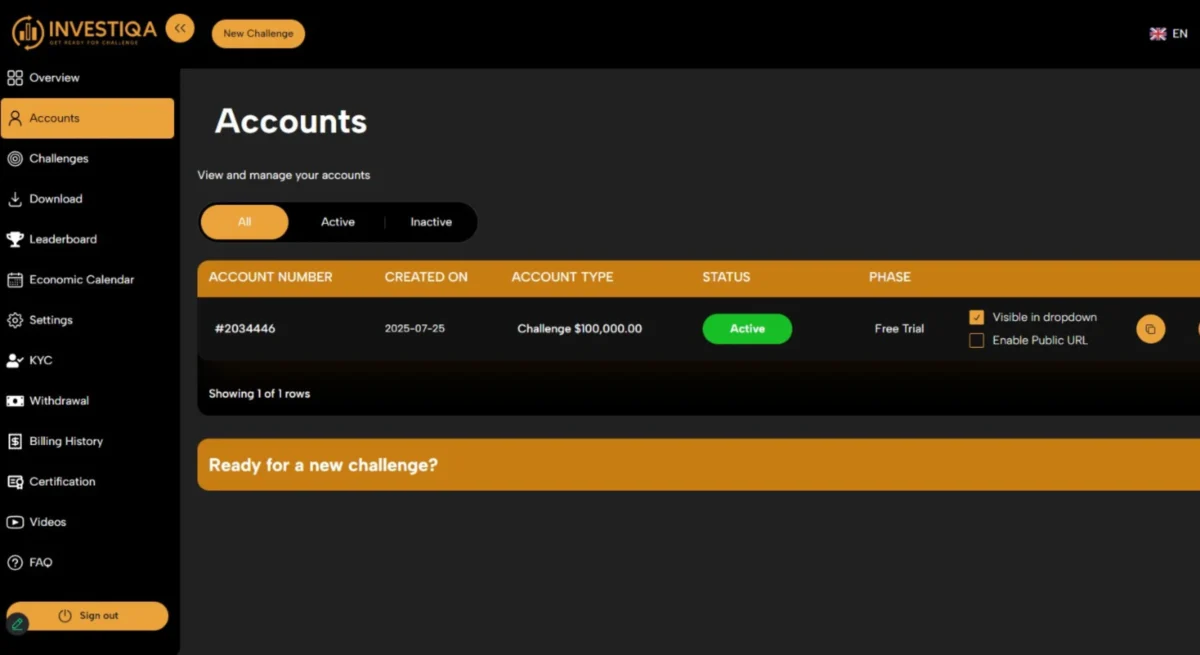
Modern prop trading firms like Investiqa offer evaluation programs where aspiring traders can demonstrate their skills through challenge accounts before receiving live capital. This system ensures that only traders with proven abilities gain access to significant funding.
What Skills Does a Prop Trader Need: Essential Technical Abilities
Market Analysis and Technical Proficiency form the foundation when considering what skills does a prop trader need. According to Investopedia’s comprehensive trading guide, successful prop traders must master multiple forms of market analysis, including technical analysis, fundamental analysis, and quantitative methods. This includes proficiency with advanced charting software, the ability to interpret complex market data and understanding of market microstructure.
Risk Management and Position Sizing represent perhaps the most critical technical skills. Prop firms evaluate traders heavily on their ability to preserve capital while generating returns. This means understanding portfolio theory, correlation analysis, volatility modeling, and advanced position sizing techniques that separate professionals from amateurs.
Strategy Development and Backtesting separate amateur traders from professionals. This requires understanding of statistical analysis, probability theory, and the ability to code trading algorithms. Prop traders must backtest their strategies thoroughly, optimize parameters and understand the mathematical foundations of their edge in the markets.
Technology and Platform Mastery becomes increasingly important as markets become more automated. Modern prop traders must be comfortable with multiple trading platforms, order management systems and analytical software. Many firms require proficiency in programming languages like Python or R for strategy development.
Top Skills Every Prop Trader Must Develop: Psychological Abilities
Emotional Control and Discipline represent the make-or-break factors when examining what skills does a prop trader need. Markets are designed to trigger fear and greed, and prop traders must maintain unwavering discipline regardless of winning or losing streaks. This includes the ability to take losses according to plan, avoid revenge trading, and stick to predetermined strategies even when emotions run high.
Decision-Making Under Pressure becomes crucial when managing live positions with firm capital. Prop traders often work in high-pressure environments where split-second decisions can significantly impact profitability. The ability to process complex information quickly while maintaining clarity of thought separates successful traders from those who struggle.
Stress Management and Mental Resilience ensure long-term career sustainability. Trading involves inevitable losses and drawdown periods that can test even experienced professionals. Prop traders must develop coping mechanisms for stress, maintain perspective during difficult periods, and bounce back quickly from setbacks.
Continuous Learning and Adaptability remain essential as markets constantly evolve. What works today may not work tomorrow, so prop traders must stay current with market developments, new technologies, and evolving trading strategies through resources like demo trading practice.
Business and Performance Management Skills
Performance Analysis and Self-Assessment help traders understand their strengths and weaknesses systematically. When evaluating what skills does a prop trader need, the ability to analyze trading performance objectively ranks extremely high. This includes maintaining detailed trading journals, calculating risk-adjusted returns and identifying patterns in decision-making that lead to success or failure.
Communication and Collaboration become important in team-oriented prop trading environments. Many firms encourage knowledge sharing, strategy discussions, and collaborative problem-solving. Traders must articulate their reasoning clearly, learn from colleagues, and contribute to the firm’s overall success.
Business Development and Networking can accelerate career advancement in prop trading. Understanding the industry landscape, building relationships with other professionals, and staying informed about opportunities at different firms can lead to better positions and increased capital allocation.
Popular Trading Strategies and Required Skill Sets
When considering what skills does a prop trader need for specific strategies, different approaches demand different competencies. High-Frequency and Algorithmic Trading require exceptional technical skills including programming ability, mathematical modeling, and understanding of market microstructure. Traders in this space must develop and maintain complex trading systems while monitoring their performance continuously.
Momentum and Trend Following Strategies require strong pattern recognition skills, disciplined execution, and the ability to ride trends while managing risk appropriately. These approaches demand patience during consolidation periods and aggressive execution during breakout scenarios.
Statistical Arbitrage and Pairs Trading involve sophisticated mathematical modeling, correlation analysis and mean reversion strategies. Traders must understand statistical concepts deeply and implement complex hedging strategies across multiple instruments.
Event-Driven and News Trading require rapid information processing, fundamental analysis skills and the ability to act quickly on market-moving events. These strategies demand strong research capabilities and excellent timing, skills that can be developed through risk management training.
Frequently Asked Questions
Q: How long does it take to develop the skills needed for prop trading? A: Most successful prop traders spend 2-3 years developing their core skills, though some platforms like Investiqa offer accelerated learning programs with mentorship. The timeline depends on your starting knowledge, dedication to learning, and ability to practice consistently. Focus on building a strong foundation rather than rushing the process.
Q: Can these skills be learned, or do you need natural talent? A: While some individuals may have natural advantages in areas like pattern recognition or emotional control, all essential prop trading skills can be developed through dedicated study and practice. Many successful prop traders started with no finance background but developed expertise through discipline and proper guidance.
Q: What’s the most important skill for aspiring prop traders to develop first? A: Risk management should be the absolute top priority. You can have excellent market analysis skills, but without proper risk management, you’ll eventually face significant losses. Start with position sizing, stop-loss discipline, and drawdown management before focusing on complex strategies.
Q: How do prop firms evaluate these skills during the hiring process? A: Most reputable prop firms use multi-stage evaluation processes including written tests, strategy presentations, and live trading challenges. Platforms like Investiqa use evaluation accounts that test traders across multiple skill areas including profit generation, risk management and consistency over extended periods.
Q: Do I need advanced degrees in finance or mathematics? A: While quantitative backgrounds can be helpful, they’re not absolutely required. Many successful prop traders come from diverse educational backgrounds. What matters most is your ability to learn continuously, think analytically and execute disciplined trading strategies. Focus on developing practical skills rather than worrying about formal credentials.
Q: How important are programming skills for modern prop trading? A: Programming skills are increasingly valuable, especially for strategy development and backtesting. However, not all prop trading roles require coding ability. Some firms specialize in discretionary trading where pattern recognition and execution skills matter more than programming. Evaluate your interests and strengths to determine the best path forward.
Your success as a prop trader depends on developing a comprehensive skill set that combines technical expertise, psychological resilience, and business acumen. Understanding what skills does a prop trader need represents just the first step in your journey. Whether you’re just starting out or looking to refine existing abilities, platforms like Investiqa provide structured environments where you can develop these capabilities with proper support, mentorship and gradual capital increases as you prove your competence.