A Comprehensive Guide by INVESTIQA

Do you trade on instinct or with a plan? The difference between successful traders and those who struggle often comes down to one crucial element: having a structured approach. Learning how to build a trading plan is the foundation of consistent profitability and risk management in today’s volatile markets.
Without a clear roadmap, trading becomes gambling. With a well-crafted plan, you transform into a disciplined professional who makes calculated decisions based on predetermined criteria. This comprehensive guide shows you how to build a trading plan that helps you trade consistently and manage risk effectively, whether you’re starting with Investiqa’s demo account or preparing for funded trading challenges.
Why You Need How to Build a Trading Plan!
The Power of Structure in Trading
When you build a trading plan, you create a framework that eliminates emotional decision-making during market volatility. Research shows that traders with written plans experience 30% fewer losing months compared to those who trade impulsively. This structure becomes your anchor during both winning streaks and challenging periods.
Key Benefits of Having a Trading Plan:
- Consistency: Standardized entry and exit criteria remove guesswork
- Risk Control: Predetermined position sizes protect your capital
- Emotional Discipline: Clear rules prevent fear and greed from driving decisions
- Performance Tracking: Documented strategies enable meaningful analysis
- Scalability: Proven methods can be applied to larger capital amounts
Common Pitfalls Without a Plan
Traders who don’t build a trading plan often fall into predictable traps:
- Overtrading during emotional highs
- Revenge trading after losses
- Inconsistent position sizing
- Lack of clear profit targets
- No systematic approach to risk management
At Investiqa, we’ve observed that traders who complete our educational modules and build structured trading plans perform significantly better in our evaluation challenges.
Key Components When You Build a Trading Plan
Essential Elements Every Plan Must Include
When you build a trading plan, certain components are non-negotiable. These elements work together to create a comprehensive framework for professional trading.
1. Trading Goals (Financial and Personal)
- Specific profit targets (monthly, quarterly, yearly)
- Risk tolerance limits
- Time commitment expectations
- Career development objectives
2. Risk Management Rules
- Maximum risk per trade (typically 1-2% of account)
- Position sizing formulas
- Stop-loss placement strategies
- Maximum daily/weekly loss limits
3. Entry and Exit Criteria
- Technical indicators or patterns
- Fundamental analysis requirements
- Confirmation signals needed
- Profit-taking strategies
4. Market Selection
- Specific instruments to trade
- Preferred timeframes
- Trading session schedules
- Market conditions to avoid
Defining Your Risk-Reward Ratios
One crucial aspect when you build a trading plan is establishing clear risk-reward ratios. This determines how much you’re willing to risk for each dollar of potential profit.
Common Risk-Reward Scenarios:
- 1:2 Ratio: Risk $100 to potentially gain $200
- 1:3 Ratio: Risk $100 to potentially gain $300
- 1:1.5 Ratio: More conservative, suitable for high-probability setups
Calculation Example: If your stop-loss is 50 pips away from entry and you want a 1:2 ratio, your profit target should be 100 pips away. This mathematical approach removes emotional decision-making from your trading.
Step-by-Step Guide to How Build a Trading Plan
Step 1: Set Your Objectives
Begin by defining what you want to achieve through trading. Are you supplementing income, building wealth, or pursuing trading as a career? Your objectives will influence every other component of your plan.
Questions to Consider:
- What’s your target monthly return?
- How much time can you dedicate to trading?
- What’s your risk tolerance?
- When do you want to achieve your goals?
Step 2: Choose Markets and Instruments
Select markets that align with your schedule, capital, and expertise. Forex markets offer 24-hour trading, while stock markets have specific hours. Consider factors like:
- Volatility levels suitable for your strategy
- Liquidity requirements for your position sizes
- Correlation patterns between different instruments
- News sensitivity and fundamental drivers
Step 3: Define Entry and Exit Rules
Create specific criteria for when to enter and exit trades. This removes emotional decision-making and ensures consistency.
Entry Criteria Example:
- Price breaks above 20-day moving average
- RSI confirms momentum (above 50)
- Volume increases by 20% above average
- No major news events in next 4 hours
Exit Rules Example:
- Stop-loss: 2% below entry price
- Profit target: 4% above entry price
- Time-based exit: Close position after 5 days if no movement
Step 4: Plan Position Sizing and Risk Limits
Determine how much capital to risk on each trade. Most successful traders risk 1-2% of their account per trade, ensuring they can survive multiple consecutive losses.
Position Sizing Formula: Position Size = (Account Balance × Risk Percentage) ÷ (Entry Price – Stop Loss Price)
Example:
- Account: $10,000
- Risk per trade: 2% ($200)
- Entry price: $50
- Stop loss: $48
- Position size: $200 ÷ $2 = 100 shares
Step 5: Establish Review and Journaling Process
Create a system for tracking and analyzing your trading performance. This includes:
- Daily trade logs with entry/exit reasons
- Weekly performance reviews
- Monthly strategy assessments
- Quarterly plan adjustments
Document both winning and losing trades to identify patterns and improve your approach.
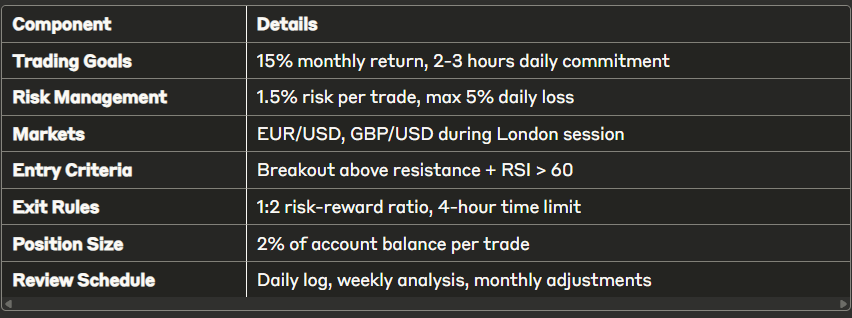
Sample Trading Plan Template
Maintaining & Adapting Your Trading Plan
Periodic Performance Reviews
Your trading plan isn’t static—it should evolve with your experience and changing market conditions. Schedule regular reviews to assess:
- Win rate trends over different timeframes
- Average risk-reward ratios achieved
- Emotional discipline adherence
- Strategy effectiveness in various market conditions
Adjusting to Changing Market Conditions
Markets evolve, and successful traders adapt their plans accordingly. When you build a trading plan, include provisions for:
- Volatility adjustments during major economic events
- Seasonal trading patterns in different markets
- Correlation changes between instruments
- Technology updates affecting execution
Learning from Mistakes
Document and analyze losing trades to extract valuable lessons. Common areas for improvement include:
- Entry timing optimization
- Stop-loss placement refinement
- Profit-taking strategy enhancement
- Risk management rule adherence
At Investiqa, we encourage traders to view losses as tuition fees for market education. Our community forums provide space for sharing experiences and learning from others’ mistakes.
Advanced Considerations
Psychological Aspects On How to Build a Trading Plan
When you build a trading plan, address the mental game:
- Stress management techniques
- Confidence building strategies
- Dealing with drawdowns mentally
- Maintaining discipline during winning streaks
Technology Integration
Modern trading requires technological support:
- Trading platforms and tools
- Risk management software
- Performance tracking systems
- News and analysis feeds
Regulatory Compliance
Ensure your plan complies with relevant regulations:
- Tax implications of trading activities
- Reporting requirements for substantial gains
- Leverage restrictions in your jurisdiction
- Professional licensing if applicable
Learning how to build a trading plan is the first step toward professional trading success. By following this comprehensive framework, you create a structured approach that promotes consistency, manages risk effectively, and provides clear guidelines for decision-making.
Remember that the best trading plan is one you’ll actually follow. Start simple, test your approach with small positions or demo accounts, and gradually refine your strategy based on real market experience. Whether you’re preparing for Investiqa’s funding challenges or trading with personal capital, a well-crafted plan becomes your roadmap to consistent profitability.
The key to success isn’t just knowing how to build a trading plan—it’s having the discipline to follow it consistently. Download our free trading plan template and start planning your next trade with clarity and confidence.
Build your trading plan and 🔗 Start Your Free Challenge Now at Investiqa.com