Box Theory in Trading
📖 Understanding the Concept
In a previous article, titled “Support and Resistance Are Crucial for Reading Markets”, the concept of box theory was briefly introduced. Due to the high level of interest and subsequent questions, this article delves deeper into understanding and applying the box theory in trading.
🔲 What Are Boxes in Trading?
A box represents a time-based correction in the market. Broadly, there are two types of corrections:
- Price Corrections: These occur when the price moves against the prevailing trend. A price correction reflects a weakening of a bullish trend or a temporary rally in a bearish trend. These corrections often display wave-like formations.
- Time Corrections (Consolidations): Here, the price moves sideways with little directional bias, reflecting a temporary pause or balance between supply and demand. There are no distinct waves, and corrections appear flat.
Boxes represent consolidation zones—intermediate phases between price impulses, observable across short or long timeframes. Their main advantage: they offer trading opportunities in both trend-following and countertrend strategies.
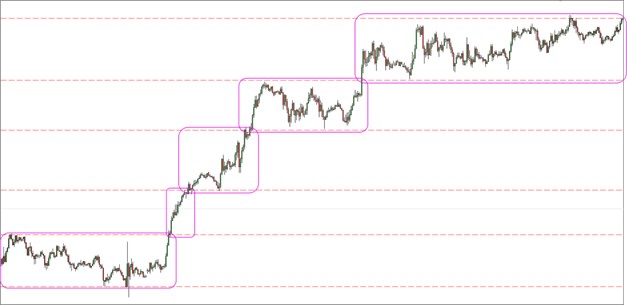
📉 Price typically moves from one box to the next during an impulse phase.
📏 Box Proportions and Breakout Strategy
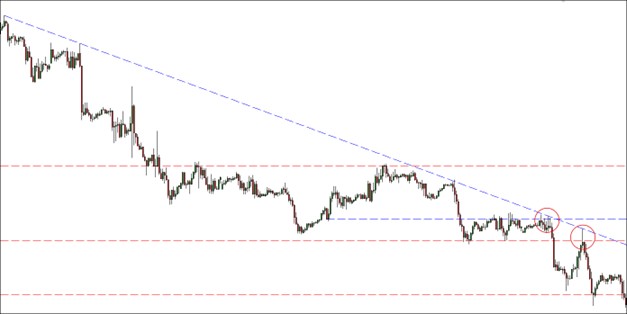
Boxes are often overlapping or closely aligned.
To identify a breakout level, shift the box range to align with the most recent price impulse.
Though a 1:1 ratio (height of box = length of impulse) is a standard assumption, variations occur frequently. Notably, some boxes mirror prior price action (so-called “mirror reflections”).
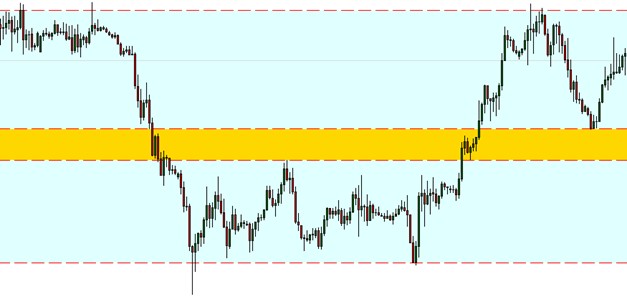
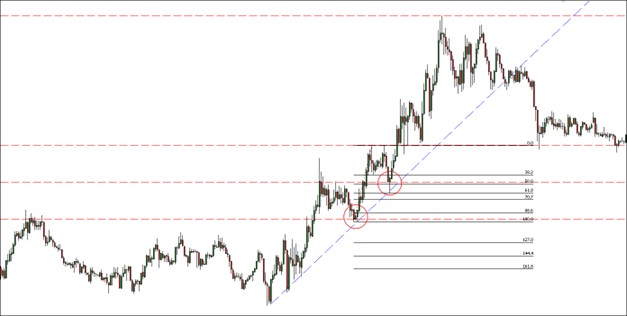
📈 Strong impulses often span twice the box size, while corrections tend to stay within a single box. This aligns with the 50% Fibonacci retracement level, which serves as a favorable entry point.

📊 Integrating Box Theory with Other Tools
To enhance box analysis, traders often combine:
- Support and Resistance Levels
- Trendlines
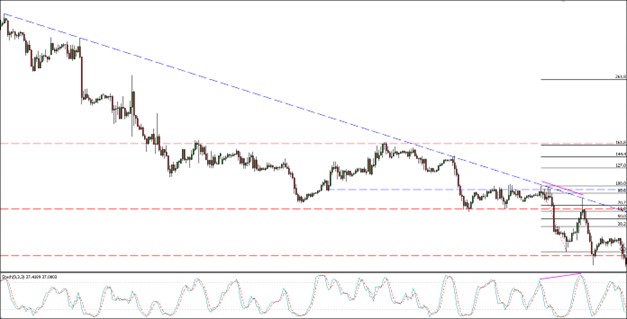
- Fibonacci Levels: Most relevant: 38.2%, 50%, 61.8%, 70.7%

- Momentum Oscillators: Such as RSI, MACD, or Stochastic. When these indicators diverge from price, it adds further decision-making clarity.
📌 Example: When multiple indicators (e.g., Fibonacci, trendline resistance, Stochastic divergence) align near a box boundary, the probability of a successful trade increases substantially.
📈 Practical Scenarios
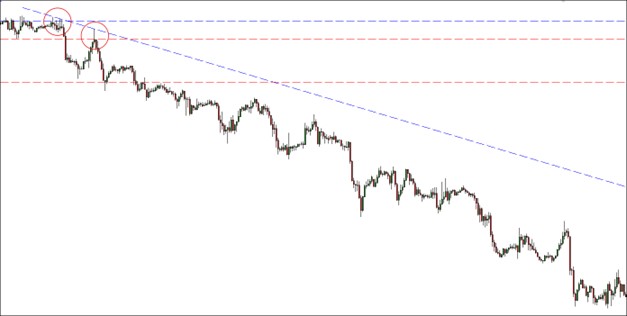
In a bearish scenario, if price reacts to the top of a box near a trendline and retracement levels, a short position becomes attractive.
Conversely, in a bullish trend, price rejection from a box’s lower boundary, reinforced by Fibonacci 50% or 61.8% levels and trendline support, suggests a long opportunity.
✅ Final Thoughts
Box theory is a powerful yet simple trading concept. It helps identify:
- Directional bias (trend)
- Key price zones (targets and entries)
When combined with other indicators, box theory:
- Validates trade setups,
- Increases certainty,
- Helps traders avoid noise and focus on actionable zones.
Mastering the box theory is a fundamental step toward professional-level technical analysis.
📌 Summary of Tools for Confirmation
- Support and Resistance levels
- Trendlines
- Fibonacci levels (38.2%, 50%, 61.8%, 70.7%)
- Oscillator divergence: RSI, MACD, or Stochastic